Family Histories

       Home       NEW Updates      About Us       Feedback      Historic Sites       Consultants          Contact Us       Terms/Conditions


BROWN Edward James "Jim"

Compiled by Gordon Freegard based on research by Merilyn Stewart

Resident of Ongerup from 1948 to 1980

(Written by his son, Geoff Brown)


Jim Brown was born in Perth on 4 October 1920 to Joseph Edward Brown and May Elsie Brown.

Jim's father, who had been in the AIF, returned from France in 1919. Joe, as he was known, had enlisted in the AIF as a Private and returned from the war as a Lieutenant, honored with a Military Cross.

The family left Perth soon after Jim was born, and he spent most of his childhood in Esperance, Scaddan, Grass Patch, and Katanning. Upon leaving school as a 15-year-old, Jim obtained a Junior Clerk position with the Katanning Road Board.


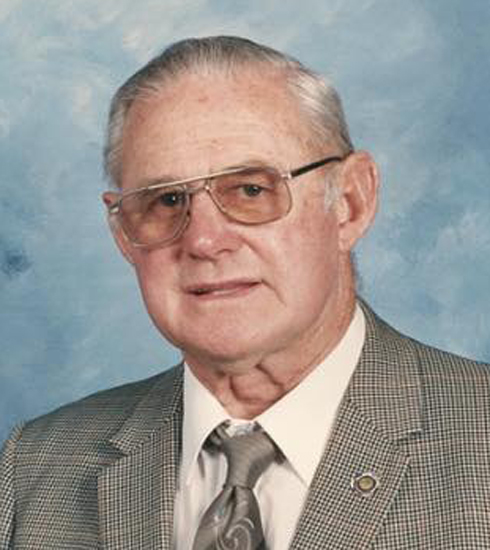
EDWARD JAMES "JIM" BROWN         #1


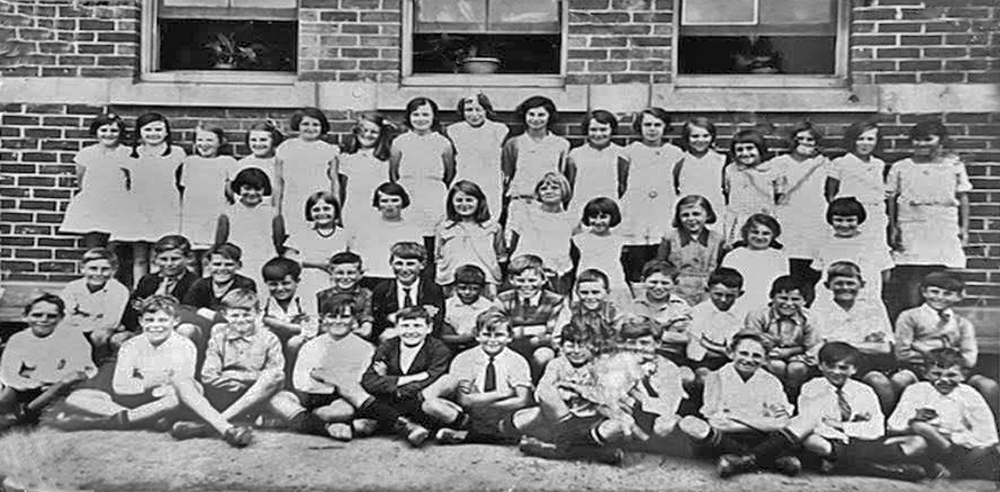
 KATANNING JUNIOR HIGH SCHOOL 1934

 JIM BROWN SECOND FROM THE RIGHT  SECOND BOTTOM ROW        #2
 

The job at the Road Board didn't last long as the family returned to Perth in 1935. Jim then acquired Junior Clerking roles at the WA Chamber of Manufacturers and later with the Prudential Assurance Company. In 1940, Jim enlisted in the RAAF and, over the next seven years, saw service in many parts of Australia, including Darwin during the Japanese bombing raids and later in the Allied Occupation Forces in Japan.
On 12 May 1948, Jim was discharged from the RAAF, and like many ex-servicemen, began looking for employment. For a time, he worked at the Midland Railway Workshops as a Trainee Fitter. However, not being enamored with the fitting traineeship, Jim decided to look for other opportunities.

Through a family acquaintance, Ray Newby (of Ongerup), Jim learned that there was a small trucking business for sale in Ongerup. The business was involved in trucking/carrying with contracts to the State Government. It also involved agencies with the Neptune Oil Company, Elder Smith and Co., and a mail run. Jim had managed to save a small amount of money whilst in the service, and he decided that together with his deferment pay, it would be enough to buy a business. After visiting the business with his father Joe, Jim decided to purchase the Ongerup business.

Included with the business were a 24-foot cattle crate on a semi-trailer body (no truck) and three town blocks, one of which incorporated a fairly sizeable but rudimentary corrugated iron shed, the second a small two-room shack, with the third lot vacant. So, in 1948, after purchasing a 5-ton Austin truck in Perth, off he drove, without a driver's license, to begin a new life and long association with the town of Ongerup.
 

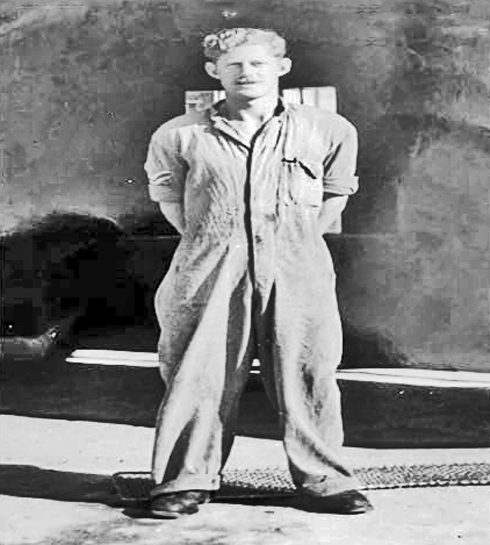
   READY FOR WORK AT ONGERUP
 JIM BROWN  STILL SPORTING THE R.A.A.F.  KIT  1948      #3


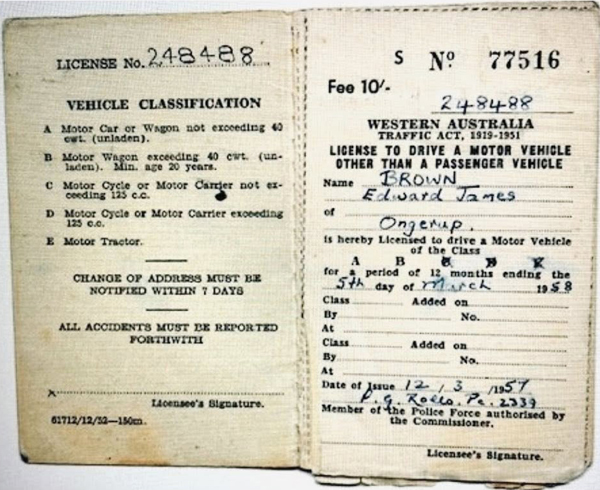
JIM BROWN'S DRIVERS LICENSE         #4
 

There was no police presence in Ongerup at that time, and on seeking an appointment with the Police Sergeant in Gnowangerup to obtain a license, the policeman said, "Just send me ten shillings, and I will send you a license!"
This license is from 1958, but it is actually a booklet that goes back to 1952, unfortunately with pages stuck together. Ten shillings was a lot of money in those days—for a driver's license!

At that time, the railway line terminated at Ongerup, and part of the government contract that Jim held obliged him to cart everything to and from the Soldier Settlement Scheme area out to and around Needilup. This obligation later expanded when the scheme opened to and around Jerramungup.

After arriving in Ongerup and taking on the business, Jim quickly became introduced to the physical challenges it presented. In his memoirs, he recounts the story where one of the first jobs he undertook was to unload 10 tons of stacked bagged (180 lbs or 80 kgs) superphosphate by himself, out of a railway wagon onto his truck, then deliver it to a farm and stack it in a space too small for the purpose. Naturally enough, although thinking himself fit and strong, he questioned himself, "What the hell have I got myself into?" Over time, though, he got used to the rigors, and things became easier.
 
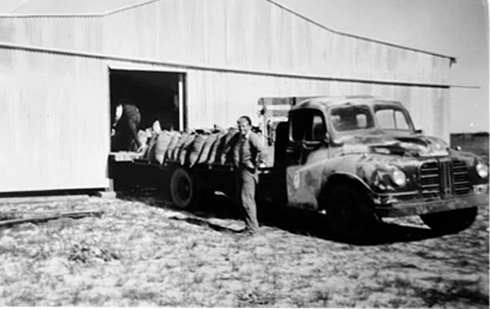
Over the ensuing years, while the railway line existed, Jim's business expanded not only due to his scheme obligations but many local farmers and businesses also sought his services. He and his staff transported many thousands of tons of goods (building materials, fencing materials, superphosphate, grain, wool, machinery, Neptune fuels, spare parts, and livestock (sheep, cattle, and pigs)) to and from the railway terminus and beyond.
 

 DELIVERING SUPER IN THE RED AUSTIN ABOUT 1952         #5
 

Jim soon became involved in life in Ongerup. He quickly became a playing member of the Football, Tennis, and Golf Clubs. With his great friend Gerald Gaze, son of Owen and Olga Gaze of "Owendale" near Gnowangerup, the two purchased some gymnasium equipment and ran classes for the young people of the area in the Ongerup Hall. It wasn't long before he was to become captain of the Ongerup Football Team, although that didn't last long because he severely injured his shoulder playing in one of the games and couldn't work for a couple of months. That put paid to his football career.
Early in his time in Ongerup, the Tennis Club managed to acquire the North Ongerup School building, which they wanted to use as a pavilion. Jim took his semi-trailer truck out where club members had lifted the small building up with jacks. He backed the vehicle in under the building, it was lowered onto the truck, and he then brought it into town so that it could be placed beside the courts. That building had an interesting life. It started life as a school, became a tennis pavilion, then became a school classroom again in 1960/61 while the Ongerup school expansion was under construction. Finally, many years later, when the new Ongerup Sporting Complex was completed, the building was acquired by a local farmer and moved to his farm. It is believed that the building still stands today.

Also, from his memoirs, Jim recounts the acquisition of the Ongerup CWA building. Around the same time as the Tennis Club acquisition, the Education Department was quitting several small rural schools, and the Ongerup branch of the Country Women's Association was able to acquire the East Ongerup School building a few miles out of town. To get that building into town, local people once again jacked it up and then slid a big, forked tree under it. It was a bigger building and too big for Jim's trailer. Gerald Gaze brought his tractor in, hitched it up to the tree, and pulled the building along the road into town. Nobody worried about the road being gouged out a bit in those days. The building was placed in what was then called Third Avenue. The building is still proudly used today by the CWA.

Jim talks of the state of the roads in those days. There was no bitumen, and most of the roads were nothing better than tracks. Most roads were severely corrugated, and it was not uncommon in the wetter months to become bogged in the middle of the main roads. The state of the roads in those days contributed to a heavy toll on Jim's trucks. Broken axles, springs, and damaged tires together with failure of engines that were generally underpowered often meant lengthy holdups and big repair bills.

The sporting associations, coupled with meeting the local people and those folks on his mail run, meant that Jim quickly established himself in the community. Jim wrote quite an extensive memoir over the few years before his passing. There are many stories in his writings about his early times in Ongerup. Some talk about the people and characters who lived on his Mail Run circuit, which involved a 50-mile (80-kilometer) loop from Ongerup out and around (in those days) the remote Needilup area. He got to know many of the pioneers of the area, and names such as the Browns (no relation), Carneys, McHardys, Pococks, and Mears feature.

In town, there were a number of traders including the Campbells (mechanical repairs), Edwards (mechanical repairs, fuel sales, and International Agents), Slees (general store and gallon license), J.B. Weir (general store and fuel sales), together with the R&I Bank, the Ongerup Needilup Coop, and the local café—all being strongly supported.

In September 1950, Jim married Madeline Gaze (sister of Gerald). Over the next five years, Jim and Madeline produced three sons: Geoffrey, Peter, and David. All the boys completed their primary school education at Ongerup Primary School prior to heading to Perth for boarding school to complete their high school. Jim was an extremely good community man. Over the years, he became involved in just about everything in Ongerup.

In the 50s, 60s, and 70s, the RSL in Ongerup was very strongly patronized, with ANZAC Day being a focal event in the calendar year. Jim was heavily involved in the RSL administration and the organization of the Ongerup ANZAC Day march and remembrance services, often being the MC. In those times, the Hall (which was and is a good size) would pack out for the commemorative services on ANZAC Day.

Early in the 1960s, the RSL decided that they would like to erect a memorial to the servicemen and women who had served from the Ongerup area and paid the ultimate sacrifice. To raise the funds to do so, the committee decided to "do some cropping." Although it is not clear whether they had permission to do so, with the help and generosity of some local farmers who supplied machines, seed, and superphosphate, they planted and harvested quite a few acres of wheat on the local water catchment reserve and on some wide road verges not far from town. As luck would have it, the growing year was very good, and the price was strong. This enterprise resulted in a very financially successful Ongerup Branch of the RSL.

Subsequently, the War Memorial was erected at the corner of Eldridge and Jaekel Streets. However, after the Memorial had been erected and paid for, there was still quite a substantial amount of funds left in the bank from the cropping enterprise. In due course, these surplus funds were utilized to construct the building that housed the Ongerup Fire Truck and the Ambulance. After this building was built and paid for, there were still some remaining funds, which were donated to assist in the building of the Ongerup Sports Pavilion.

In 1955, Jim joined the Gnowangerup Masonic Lodge, eventually becoming its Master and then Grand Master. This meant a lot of traveling to and from the other Lodges as far away as Tambellup, Kojonup, and Katanning. Jim remained a member of the Gnowangerup Lodge for many years after he left Ongerup.

A small group of Ongerup people revived the Progress Association in the 1950s, and one of the first things they did was to lobby for and acquire a St. Johns ambulance. Jim was a leader and coordinator among that group and immediately set about obtaining an Advanced First Aid Certificate so he could be qualified to drive the Ambulance.

During the first few years that Ongerup acquired an Ambulance, Jim and several of his colleagues facilitated First Aid courses at nighttime at the school, which were patronized by many people in the district. For Jim and several others, attending to the ambulance duties involved many call outs at all times of the day and night and frequent trips to the Gnowangerup Hospital and sometimes Katanning. Jim remained involved with the Ongerup Ambulance service until he left Ongerup.


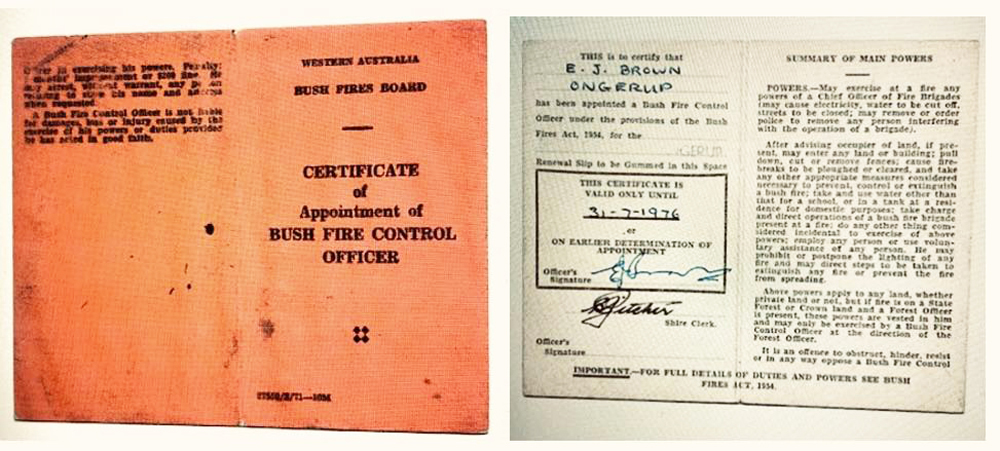
   JIM BROWN'S BUSH FIRE CONTROL OFFICER CERTIFICATE      #6
 

The Ongerup Volunteer Fire Brigade was also a beneficiary of Jim's community spirit. He was, for a time, Captain of the Brigade and was a driver in influencing the RSL to fund the building to house the fire truck. In fact, one of his retired trucks, an International AA 180, became the first fire truck.
As mentioned previously, he was involved in the Ongerup Football Team, for a while as Captain. He was also quite a good tennis player and a member of the Tennis Club. His main contribution to sporting activities was involvement in the Ongerup Golf Club. Over many years, he was either the President or the Captain of the Golf Club and spent countless hours with some other members voluntarily working on the links, greens, and fairways to develop the course into a viable and workable community facility. The course, in fact, developed an admirable reputation, and on Open Days, starters would travel from far and wide, often numbering around 100.


In 1959, Jim was approached to become a Justice of the Peace. Although being concerned that in doing so it may bring about some difficulties dealing with people and matters in the small community he lived in, in 1960 Jim completed the formalities and was appointed a JP. Over the years, Jim "sat on the bench" in numerous cases in the Ongerup Court Room. In his memoirs, Jim says that not once, because of the cases that he adjudicated on, did he ever receive any undue criticism or animosity. Perhaps the traits of a just and fair man?
For quite a few years after the establishment of the Police Station in Ongerup, it was manned by a single policeman who covered the district from Ongerup down through Needilup, Jerramungup to Bremer Bay. If the policeman required law enforcement help, the nearest was in Gnowangerup, and depending on where the matter was occurring, assistance might be several hours away. Jim's boys recall that on a number of occasions Jim (and several other townsmen) were called upon to accompany and support the policeman with some difficult situations. Jim was always willing to help.

During the 50s and 60s, the Ongerup Primary School thrived and expanded with strong and growing student numbers. Particularly while their boys attended the school, both Jim and Madeline were strong supporters of the Parents and Citizens Association. For a few years, Madeline was Secretary, and Jim contributed in a number of ways, including helping to form the school sporting grounds and running events.


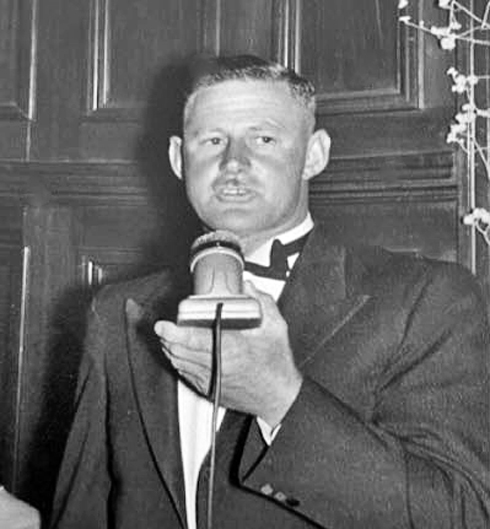
  JIM BROWN WAS MC AT  MANY WEDDINGS        #7
 

One of the big fundraisers for the P&C in those days was running monthly picture shows on Saturday nights, using the school's 35-millimeter projector. These shows were held in the Ongerup Hall, which even in those days had a reasonably large seating capacity (perhaps 100 or a few more) and boasted an elevated stage that included a wide movie screen contributed by the P&C. Jim, Jim Campbell, Len Faulkner, and several others were essentially the coordinators and operators of these activities.
Running the shows involved obtaining a movie from Perth, which would come down on the train to Broomehill and then on the road bus out to Ongerup. The 35-millimeter movies consisted of a number of large reels (about 450 mm in diameter) loaded with reams of celluloid film. The number of reels required for a movie was determined by its length (time). When a reel ran out, it took quite a few minutes to load the next one onto the projector. This meant that those in the cinema would be plunged into darkness for the time it took to change the reel. The P&C eventually overcame this situation with the acquisition of a second projector. Then it was a challenge to get the next reel started just as the previous one finished.

Of course, there were many events of consternation and high jinks when a projector bulb blew out, the film jammed, or even when a reel was loaded out of sync. Nevertheless, these cinema events were strongly supported, and mostly the hall was packed to capacity, with people from the district coming in from far and wide. At intermission, there was always a treat for young and old, as the café just down the street opened, and cool drinks, lollies, and ice creams were enjoyed. They were great community events!

In around 1956, a family by the name of Ray decided that Ongerup needed a hotel. They approached Jim and several other people in the town and district to form a syndicate to finance the venture. This resulted in five shareholders in the venture, Jim being one. The hotel was completed and opened in 1957 after Jim and respected farmer Mr. Andy O'Neil traveled to Katanning to successfully acquire a license to operate from the then Minister in Charge of the Licensing Authority. Jim remained a shareholder until he left Ongerup to retire in Perth.

When the railway line closed in 1957, it meant a very significant change to Jim and Madeline's business. Overnight, the government contracts evaporated, and suddenly the trucking side of the business changed from one of relatively short haul to one of uncertainty. For the case of fertilizer (superphosphate), fuel, and wool, there was a need to cart much longer distances to and from Albany. Unfortunately, for Jim and Madeline's business, the one thing that they were not able to do was obtain a license to cart grain from the Ongerup and surrounding CBH bins to Albany Port. This meant that, even though the E.J. & M. Brown business was well supported by local businesses and farmers, profitability was not good enough to survive in the long term, and diversification was a must.

Over the next few years, diversification did happen, and agencies for Elder Smith, Neptune Oil Company, Chamberlain, Bearing Services, CIG, Yamaha, and Mobil Gas became more of a focus and played a big part. In addition, Jim completed a Gas Installer Certificate, resulting in numerous venues and homes in the town and district being equipped with gas lighting, stoves and ovens, water heating, and refrigeration—all from bottled gas. All these activities, together with the trucking, super spreading, agencies, and the mail run, managed to place the business on sustainable footing.

In the 1950s, 60s, and 70s, in country towns such as Ongerup, doors were rarely locked, and keys could often be found in vehicle ignitions anywhere in town or on farms. Jim and Madeline's boys recall that whenever the family went away, the back door of the shed and house were always left with the key in them. Honesty was paramount in the community in those days, and if the Brown family was away, it was accepted that if any of Jim's clients needed a part, a drum or two of fuel, or a bottle of gas, they helped themselves and left a note on the office desk after entering through the back door of the shed. Jim and Madeline never denied anyone service and, on hundreds of occasions, helped customers with whatever they needed well out of business hours, Sundays, or public holidays, including Easter and Christmas.

In the early 70s, Jim and Dorothy Campbell decided to retire and sell their school bus round. Jim and Madeline bought the round, which came with an ancient Mercedes bus that had done innumerable miles. Jim and Madeline both drove the bus and greatly enjoyed the experience. The bus run remained part of the Brown business until Jim left Ongerup.

In 1974, Jim and Madeline parted ways, with Madeline moving to Perth. Jim remained in Ongerup, running the business and maintaining the school bus run.

Jim was a very good public speaker, and over the years, this led to him being called upon to chair numerous meetings and be the Master of Ceremonies at many public events and marriage ceremonies in the Ongerup district.

One of Jim's proudest moments was being asked to act as Master of Ceremonies at the opening of The Ongerup Wildflower Museum, just before leaving Ongerup.

After two hip replacements in the late 70s and his declining ability to undertake the physical work of his traditional business, and after many years of moving thousands of tonnes
 of goods, freight, and livestock throughout the district and up and down the road to Albany, Jim decided it was time to sell out and retire. After 32 years and what could be considered a considerable legacy in the contribution he made to the community and town, Jim left Ongerup to retire in Perth in 1980.
The people of the Ongerup district gave him a send-off with a pewter platter and goblets, and the school kids of the bus run presented him with a gift of two pewter mugs. Jim passed away at the age of 92 on 29 May 2012.
Part of his ashes have been placed in the Remembrance Wall at Ongerup Cemetery.”


Every endeavour has been made to accurately record the details however if you would like to provide additional images and/or newer information we are pleased to update the details on this site. Please use CONTACT at the top of this page to email us. We appreciate your involvement in recording the history of our area.


References:                 Article:      Merilyn Stewart
                                                  Jeff Brown

                                  Image:     1, 2, 3, 4, 5, 6, 7      Jeff Brown


Copyright : Gordon Freegard 2023 - 2026